Showing posts with label Books. Show all posts

Tuesday, November 15, 2011


Found Poem-The Book Thief

One eye open,
one still in a dream,
I knelt down and
extracted his soul.
The chaos of goodbye
must have shown in my eyes.
In my swollen arms,
I carried him;
carried memories.
The cemetery welcomed me
like a friend.
My knees entered the ground;
a beautiful submission.
I handed his soul to eternity
and left my broken heart
in the clumsy silence.


The next book you read should be Markus Zusak’s The Book Thief. I finished it two nights ago and I can’t stop thinking about it. The book’s been in my peripheral vision for a couple of years; I picked it up a couple of times and thought about reading it, but at any given time there are about a dozen books that I’m thinking about reading, so I never got around to it. A friend recently asked me about it ,and that brought it back to my attention and I finally settled down with great anticipation to read it.

I had high expectations, and The Book Thief blew them out of the water.

The story follows a young German girl named Liesel growing up in a suburb of Munich at the height of Hitler’s regime. In January 1939, when she is nine years old, she is given over to foster parents when, for mysterious reasons, her mother can no longer care for her. She grows up with her new foster parents in a silently anti-Nazi household, publicly participating in the Hitler Youth program and attending book-burning gatherings while her parents are secretly harboring a Jewish man in the basement. Her adopted father is the epitome of kindness and charity, teaching the illiterate Liesel how to read and write and igniting a passion for books. I can’t discuss the plot too much more without ruining it, but it’s about growing up in a scary and uncertain time, and the power of books to comfort and empower. But this is no ordinary World War II story – it’s a World War II story narrated by Death. And I can say with no qualms whatsoever that Death is the BEST. NARRATOR. EVER. He (it?) takes notice of Liesel for the first time when he comes for her little brother. (“She caught me out, no doubt about it. It was exactly when I knelt down and extracted his soul, holding it limply in my swollen arms. He warmed up soon after, but when I picked him up originally, the boy’s spirit was soft and cold, like ice cream. He started melting in my arms. Then warming up completely. Healing.”) He encounters Liesel two more times in her life as he comes to collect peoples’ souls at key moments, and he is taken with her and her story. As a non-human, Death is baffled by the things that people do, and he makes some interesting observations about human behavior. He’s not quite omnipotent, but he has a wider frame of reference than the average person does; his method of storytelling isn’t linear. As the story progresses in a mostly chronological fashion, we get periodic glimpses into the future that puts the events into larger context so we understand their significance. There are characters in the story whose deaths are described almost immediately upon their arrival on the scene…this being a WWII story, you can imagine that there’s quite a bit of death. Almost every character’s demise is mentioned long before it actually happens, and the writing here is so brilliant that even though you know far ahead of time that someone is going to die, it doesn’t soften the blow when they finally do. This is the most beautiful and gut-wrenching book I have ever read. I sobbed. When was the last time a book made you actually shed tears? I sat in my bed on Friday night and cried like I haven’t cried in ages. The last few chapters have the most exquisitely gorgeous and heartbreaking passages I’ve ever read in any book, and I’ve read a whole lot of books. You might be wondering why in the hell anyone would want to read a book that makes you cry like a baby, but just trust me, you do. It’s so sad, but so strangely beautiful in its sadness. And it isn’t sad just for the sake of pushing your buttons. There’s a point to it all….or rather, it raises a question and that question is the point: How can human beings be so awful and so beautiful at the same time? “I wanted to explain that I am constantly overestimating and underestimating the human race – that rarely do I ever simply estimate it. I wanted to ask her how the same thing could be so ugly and so glorious, and its words and stories so damning and so brilliant.” World War II is the perfect setting for a story about this dichotomy, because while Liesel is growing up in a country where indescribable cruelty is taking place and hatred is stomping around in jackboots, she and the people in her life are continuously doing small but beautiful things. Her life is hard, but it is shot through with kindness and loveliness and strength. How can we be so brutal and so kind? So evil and so divine? I don’t think there is a definitive answer to that question, but the question itself is enough to marvel at.

The Book Thief is getting a place of honor among the best books I’ve ever read. I don’t think I’ve ever been so moved and haunted by a book since ''night''. This one is going to stay with me forever. I wish someone had sat me down three years ago and told me I have to read this book, so now I’m doing that for you.

Friday, November 11, 2011


“Here we are, trapped in the amber of the moment. There is no why”.

I keep coming back to that bit of Slaughterhouse-Five. “There is no why.” In this passage, Billy Pilgrim is talking to a being from another planet. These beings don’t perceive time the way humans do – instead of perceiving one moment at a time, in a linear fashion, they see all moments in time simultaneously. Everything that has ever happened, and ever will happen, is actually all occurring at once, and has always been occurring. They don’t worship a deity and don’t believe that things happen for a reason. Death isn’t sad because although a person is dead in this particular moment, he or she is still alive in a million other moments. Death is just something that happens, and it is always marked with the (slightly fatalistic) saying, “So it goes.” The idea that “there is no why,” when I encountered it, was terrifying. I think human beings have a deep, instinctual desire to assign meaning and purpose to their lives and the things that happen around them. We really want there to be a “why,” even if we can’t figure out what it is. As intelligent, self-aware animals, we are capable of analyzing the world on a pretty high level and as a result we can be baffled and terrified by it, because we are inclined to be afraid of things we don’t understand. So, in our fear, we look for a why. If we can just assign a why, it will make sense and our sense of order will be restored. Religion fits that bill extraordinarily well. It enables people to assign a why. We are being rewarded, or punished, or the karmic wheel has made a full circle, or we are being taught something, or at the very least we can shrug and say, “It’s part of God’s plan, and his plan is not always for us to know.” I think there’s an enormous amount of comfort to be drawn from that. So the idea of there being no why is really scary, at least initially.
Then I encountered Vonnegut and his aliens, and they knocked me for a loop. I discovered Slaughterhouse-Five during a really difficult time when I was trying to drag myself out of my pit of devastation and not doing a very good job of it (at all), and I was asking a lot of questions that started with why. When something knocks us down we want to know why. Why did this happen, and why does it have to hurt so bad? So I happened to pick up this book in the midst of all this pain and angst, and I stumbled across “Here we are, trapped in the amber of this moment. There is no why,” and it set me free. Having a why can be immensely comforting, yes, but I also think that when we get knocked down and are lying there dazed, we can be so encumbered by our insistence on figuring out the why that our recovery is hampered. It’s like a weight around our necks that makes getting up again even harder than it already is, or delays our even trying until we figure it out. That was the case with me – I was so obsessed with figuring out why all this nasty stuff had happened to me that I wasn’t really even trying to get past it. So the idea that there wasn’t a why for me to figure out, instead of being scary and bleak, was liberating on a near-miraculous level. The why isn’t really what’s important, it’s the how – as in, how was I going to allow this experience to shape the kind of person I am? Forget why, I decided. It doesn’t matter. Awful things happen to people all the time – good people and bad people alike. So it goes. If we don’t allow ourselves to be bogged down by an obsession with why it happened and instead turn our energies to thinking about what we learned and what we’re going to do now, suddenly we’re empowered. And feeling empowered makes it so much easier to get back on our feet when we’ve been dealt a hard blow.

Thursday, September 15, 2011

''Fire and ice, somehow existing together without destroying each other''.

Sunday, September 11, 2011

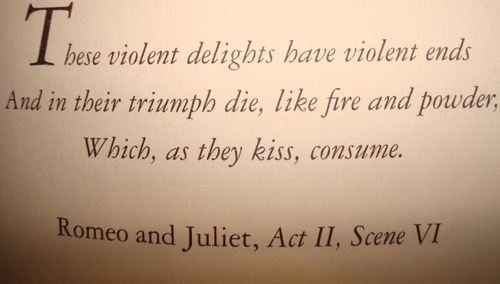
These Violent Delights Have Violent Ends.....


In Romeo and Juliet Friar Lawrence says "These violent delights have violent ends And in their triumph die, like fire and powder," (Act 2,Scene 6 ). As we see in the play the friars words “violent delights have violent ends”, has a very significant meaning to the story where things that are started violently have often have violent ends. Rather than blaming fate for all this gloom and doom, he is clearly telling an irrational Romeo, that his actions will be the cause of his "violent ends". Although Romeo has listened to Friar Lawrence's advice, he is still infatuated with the belief that fate is in control. Friar Lawrence is right in saying that Romeo's actions are controlling the situation, but Romeo fails to see that his actions control his fate.
What a lesson we can learn if we ponder on this story. Many like Romeo blame their predicament on fate or others, even though it is obviously in consequence of their actions.